So I'm a nerd, and my YouTube algorithm reflects that. As you might expect, I get a lot of human origins content: ancient DNA papers, population genetics explainers, the occasional documentary about Neanderthal interbreeding. It's great. Love it.
But last week, a series of videos came across my feed that I've been puzzling over. Here's the one that kicked it off:
I've been trying to figure out why this is being presented as controversial. And the thing is, the Jakobsson paper doesn't say what this video claims it says.
What the Paper Actually Says
The researchers explicitly support African origins. They're refining where within Africa humans evolved, not challenging that Africa is the homeland. From the press release: "We can now show that Homo sapiens have existed and evolved in southern Africa for a long time. This area has played an important role in human evolution, perhaps the most important of all."
That's it. Still African origins, just more complex geography.
The "African structured metapopulation" model (which this paper supports) has been the emerging consensus since Scerri et al. 2018. And Schlebusch/Jakobsson (the researchers behind this paper) have been publishing on Khoe-San deep divergence for years, including their 2017 Science paper estimating modern human divergence at 350,000-260,000 years ago. These are literally the same researchers who've been documenting it.
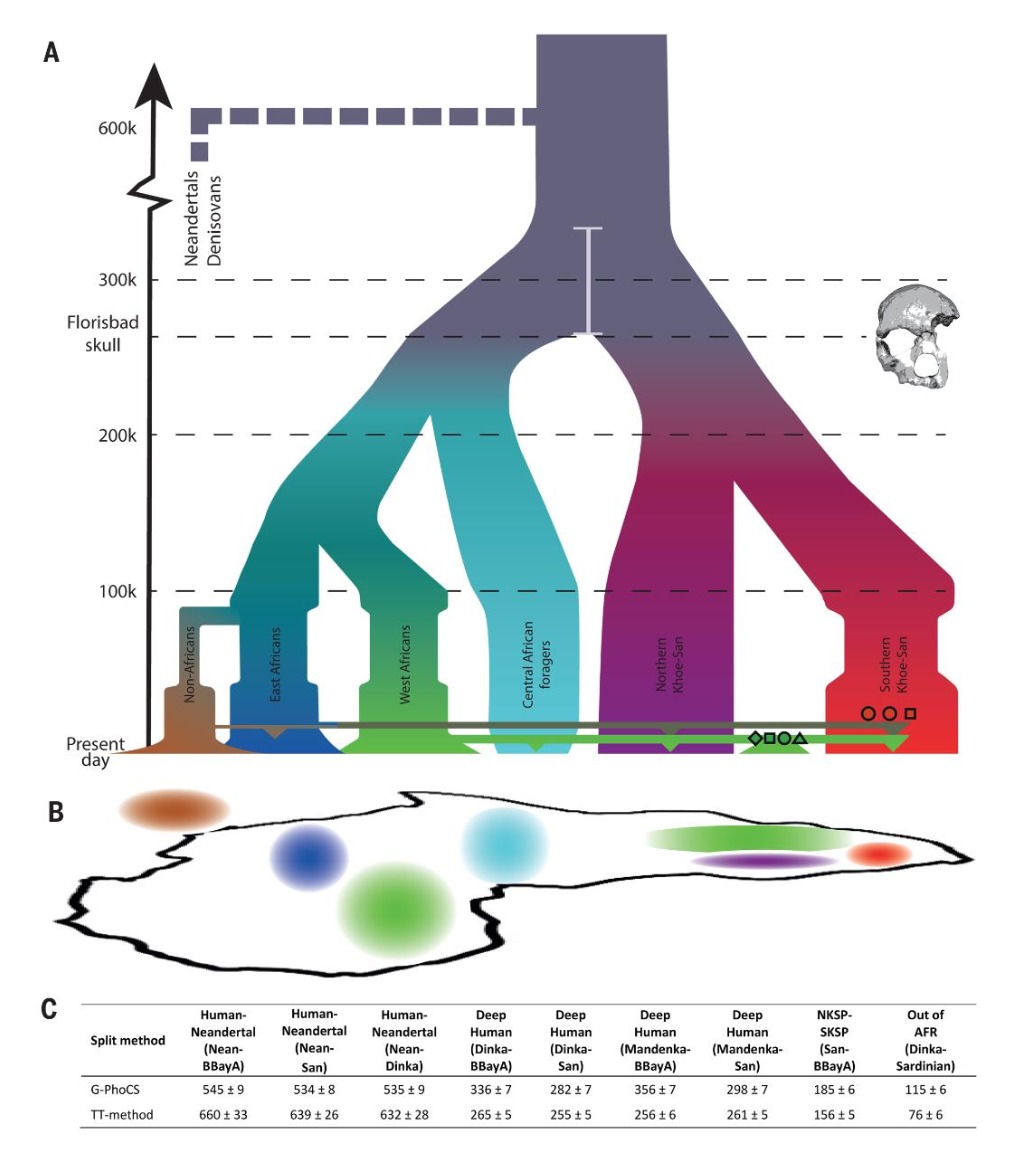
The "Buried Khoe-San" Narrative
The video claims that "for more than 30 years, the out of Africa theory buried the Khoisan, pushing the world's most ancient surviving human lineage into a conceptual basement."
This framing is bizarre. Khoe-San deep divergence has been central to African population genetics for decades. It's not suppressed information. It's literally what the field has been studying. The idea that the scientific establishment was hiding Khoe-San antiquity while simultaneously publishing papers about Khoe-San antiquity is... a lot.
The Mbuti Claims
The claims about the Mbuti are even more misleading. The video states that "their genomes harbor signals of introgression from a population older than Homo sapiens" and implies this somehow disproves Out of Africa.
So here's the thing: yes, there's evidence of archaic ghost population introgression in some African groups. This has been known since (at least?) Hammer et al. 2011 and applies to multiple populations, not just Mbuti. It's cool research! But it doesn't mean "ancestry older than Homo sapiens" in the way the video implies.
Archaic introgression in Africa is analogous to Neanderthal introgression in Europeans: it means there was interbreeding with a divergent population, not that modern humans descended from something older than themselves. And it certainly doesn't support "into Africa" migrations as primary drivers of human evolution.
What's Actually Being Conflated
I think this is where the video goes most wrong. It conflates two completely different things:
- The dispersal model: Non-Africans descend from populations that left Africa ~60kya. This remains rock solid. Nobody is disputing this.
- The simpler "single East African origin" model: The idea that there was one specific population in one specific place that gave rise to all modern humans. This has been refined (not overturned) as we've learned more about African population structure.
The video treats the refinement of model #2 as a refutation of model #1. But they're not the same thing! The paper's findings are completely consistent with Out of Africa as a dispersal model. What they're challenging is a strawman version of African origins that imagines a single, simple population.
The reality is more interesting than the controversy: human evolution in Africa was messier and more complex than the simplified textbook version, involving multiple semi-isolated populations exchanging genes over hundreds of thousands of years. But it was still fundamentally an African story.
Why This Matters
This one bugs me. Not because someone got something wrong on the internet (that's just Tuesday), but because the actual science is so much more interesting than the "mainstream science is lying to you" narrative.
The structured metapopulation model is fascinating. It suggests that what we call "modern humans" emerged from a network of African populations—some in the south, some in the east, some in the north—that were partially isolated from each other but occasionally exchanged genes. Different traits may have evolved in different places and spread through this network. It's like... human evolution was a collaboration across the continent.
That's a more interesting story than either "humans evolved in one spot in Ethiopia" or "Out of Africa is a lie." But it requires actually engaging with the complexity instead of pattern-matching to culture war narratives.
The Khoe-San Aren't a Gotcha
The Khoe-San populations carry some of the deepest divergences in modern human ancestry. That's been known and celebrated in the field for years. The researchers being cited as overturning Out of Africa are the same people who've been carefully documenting Khoe-San antiquity for their entire careers. Framing their work as suppressed information, or claiming they're now overthrowing their own field, is a weird flex.
Anyway, the actual science is worth reading. The structured metapopulation stuff is genuinely cool, and it doesn't need to be dressed up as a conspiracy to be interesting.